
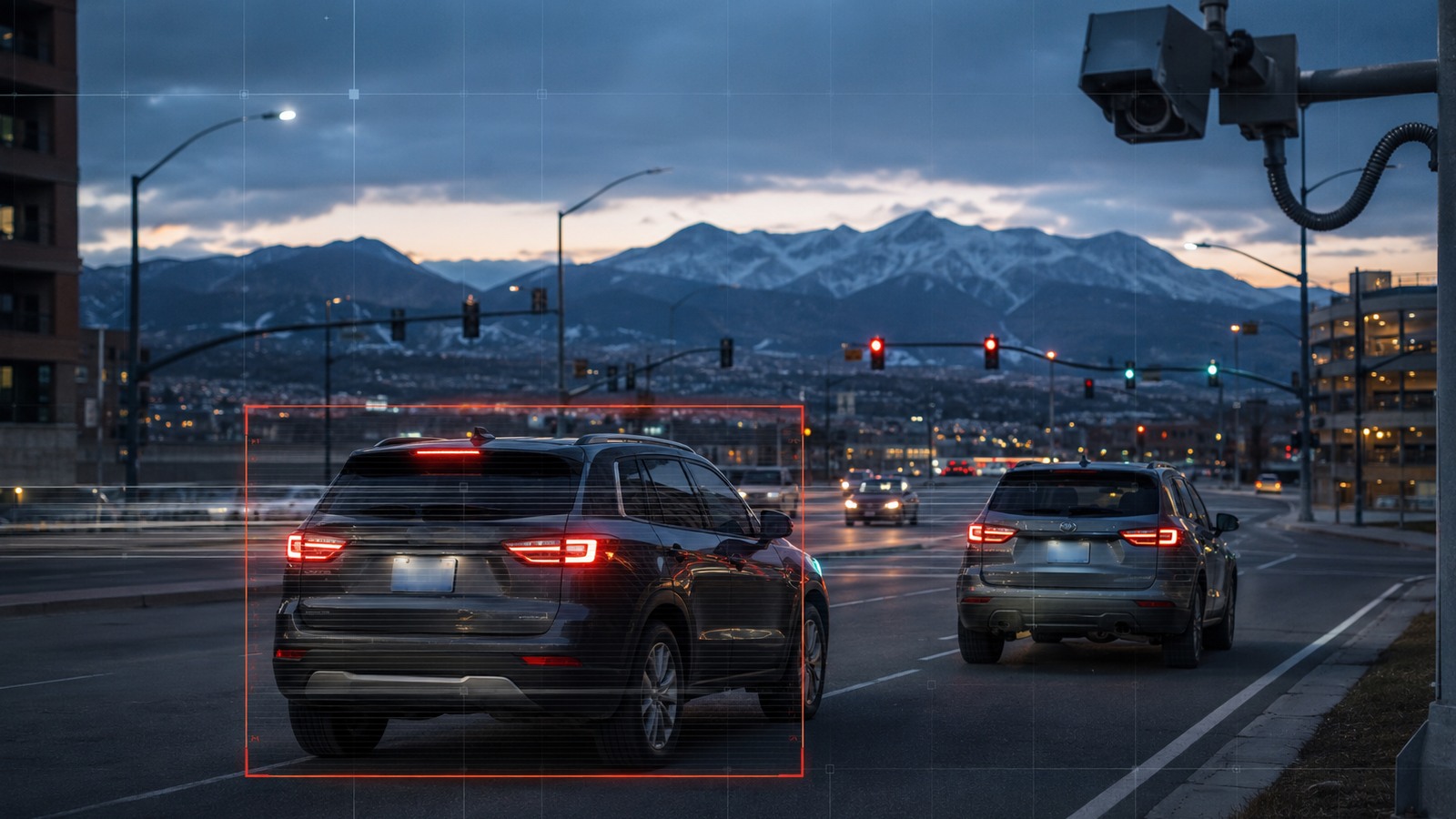
What Colorado Drivers and Families Need to Know About Flock, Private Camera Networks, and Due Process
Surveillance tools can help solve crimes; however, they can also create false certainty when a license plate hit or a video clip is treated like the whole story. Whether you knew it or not, Colorado is quickly expanding camera-based policing. So, with all this surveillance technology in place, many people are asking: How are police using this technology against Coloradans?
When Chrisanna Elser answered her door last fall, she was not greeted with a question. She was greeted with certainty. A police officer accused her of stealing a $25 package and spoke to her as if the case was already solved. The problem was that the camera-based theory was wrong. According to published reporting, police relied on surveillance data and a doorbell video, issued her a summons, and left her to gather her own evidence to prove she did not do it. That should stop every Coloradan cold. In this country, the burden is supposed to run the other way.
The Elser case highlights why the conversation about camera networks matters. Not because every camera is bad. Not because every officer is acting in bad faith. It matters because powerful tools can create powerful assumptions. And when those assumptions harden too early, good people can find themselves treated like suspects first and heard second.
This Is Not Hypothetical in Colorado
If this still sounds abstract, look at what is happening here at home. Colorado Springs Police Chief Adrian Vasquez recently said the city is nearly tripling its automated license plate readers. He also said the Colorado Springs Police Department was transitioning from Flock to Axon cameras. The city now operates a Real Time Crime Center, and its own materials explain that the center pulls together information from law enforcement databases and multiple integrated technologies. Colorado Springs has also approved a police technology surcharge on certain municipal convictions to help fund expanding tools, including the Real Time Crime Center and new vehicle intelligence cameras.
That is the local picture. This is not one camera on one pole. It is an expanding public safety ecosystem, built to move information faster and widen the field of view. Whether you think that is reassuring or unsettling, one thing is clear: this is happening now, in Colorado, and in plain sight.
What the Network Actually Looks Like
The city’s own RTCC description says the platform it uses, Fusus, can combine private and public video streams, camera locations, floor plans, live positions of first responders, drone footage, and more into a single operational picture. That alone should change how people think about the issue. We are not talking about a single device. We are talking about a system that can connect multiple sources of video and location information at once.
The related Together COS program adds another layer. For homeowners, camera registration tells police where cameras exist without giving open access to the footage. For businesses, camera integration is more substantial. The city says businesses can connect some or all of their cameras through a Fusus device so detectives can review recordings after serious crimes, and in critical events police can live stream those feeds. The city also says integrated cameras are not monitored all the time and are intended for emergency use. Those distinctions matter, and they should be understood clearly. But even with those limits, the broader point remains: public systems, private cameras, license plate readers, and digital evidence platforms can now work together in ways most people do not fully appreciate.
A Camera Hit Is a Lead, Not the Whole Case
This is where experience in trial work matters. A license plate reader may place a vehicle in an area at a particular time. That can be a useful investigative lead. But it does not tell you who was driving. It does not tell you why the vehicle was there. It does not tell you what happened before or after the moment the camera captured, and it certainly does not tell you whether the police theory is complete, accurate, or fair.
The same is true of doorbell footage, parking lot footage, and stitched-together timelines. A clip may look compelling and still be missing context. A sequence may appear tight and still leave out other explanations. Once a system points an investigator toward a person or a vehicle, confirmation bias can do the rest. Instead of asking, “What else could explain this?” the process can quietly shift to, “How do we make the rest of the facts fit what we already think happened?”
That is one reason Joe Maher’s work as an ACS-CHAL Forensic Lawyer-Scientist matters here. Science-driven evidence is only as reliable as the methods behind it and the people interpreting it. In DUI and criminal cases, we already know that machine-generated output is not self-proving. Data has to be tested. Assumptions have to be challenged. Inputs, timestamps, chain of custody, search parameters, and human interpretation all matter. Surveillance evidence deserves that same discipline. A lead may help start an investigation. It should never be mistaken for the finished truth.
Why the Backlash Is Getting Louder
The concern is no longer limited to one company or one city. Axios recently reported that doorbell cameras and surveillance technology are facing growing public backlash as more people realize how private systems can feed public investigations. The issue grew louder after Ring aired a Super Bowl ad that many viewers saw as a glimpse of neighborhood surveillance becoming normal consumer behavior.
That backlash became serious enough that the Associated Press reported Ring ended its planned partnership with Flock. Even though Ring said the integration never launched, the reaction was telling. People are asking harder questions now:
- What is retained?
- Who can request it?
- How much can be pieced together from private cameras, public systems, and evidence platforms?
Those are not fringe questions. They are reasonable questions. These are questions that freedom-loving people are bound to ask.
Why Lawmakers Are Reacting Now
In C.R.S. § 6-1-1302, the Colorado General Assembly declared that “the people of Colorado regard their privacy as a fundamental right and an essential element of their individual freedom.”
Colorado lawmakers reacted to broad, sweeping surveillance because the concern moved from theory to real-world consequences. Axios reported that the push for limits on governmental surveillance gained momentum after Elser’s case showed how surveillance data could point police toward the wrong person. At the Capitol, Senate Bill 26-070 would have restricted government access to historical location information databases, limited sharing outside an agency’s jurisdiction, and made information obtained in violation of the proposed law inadmissible. The bill advanced out of the Senate Judiciary Committee on a 5-2 vote, but it ultimately did not pass during the 2026 legislative session.
Denver also chose not to renew its Flock contract after public backlash and selected Axon for its license plate reader system, with tighter controls on data sharing and retention. You do not have to oppose every surveillance tool to see what this means. Even governments that want these capabilities are now being forced to answer harder questions about guardrails, oversight, and trust.
What to Do If Surveillance Evidence Is Part of Your Case
If you are being investigated, charged, or questioned in a case that may involve plate reader data, doorbell footage, traffic cameras, or digital location records, the first steps matter. The earlier you act, the more likely it is that important context can still be found and preserved.
- Preserve your own evidence immediately. Save dashcam footage, doorbell clips, phone location history, receipts, calendar entries, and anything else that helps establish where you were and when.
- Write down the timeline while it is fresh. Small details that feel obvious today can disappear fast under stress.
- Do not assume the government’s version is complete. A camera angle, timestamp, or vehicle match may be only part of the picture.
- Ask early what surveillance-based evidence exists. Once data retention periods expire, important material can be lost.
- Get legal guidance before the story hardens. The earlier a defense team can review assumptions and preserve evidence, the better.
If surveillance evidence is becoming part of the state’s story against you, you need more than reassurance. You need clear next steps, a disciplined review of the evidence, and a lawyer willing to slow the case down enough to test what is actually true.
Safety and Fairness Must Rise Together
Safe communities, effective police work, missing children, and stolen vehicles all matter. None of that is in dispute. But fairness, privacy, and verification matter too. As surveillance technology becomes more powerful, the standards for oversight and proof should become stronger right along with it, not weaker.
A free society does not ask people to quietly accept a conclusion simply because the system says so. It asks whether the evidence is reliable, whether the conclusion is justified, and whether the process still honors the presumption that a person is innocent until proven guilty. That is not anti-police. That is due process and the preservation of privacy.
Frequently Asked Questions About Flock Cameras and Surveillance Evidence
Can a License Plate Reader Prove Who Was Driving?
Not by itself. A license plate reader may place a vehicle in a particular area at a particular time, but it does not automatically establish who was driving, why the vehicle was there, or what happened before and after the image was captured.
Can Colorado Springs Police Access Private Camera Footage?
It depends on how the camera owner participates. Under the Together COS program, homeowners who register cameras still control what footage they provide. Participating businesses can integrate cameras so detectives can review recordings after serious crimes and live stream feeds during certain critical events.
Can Surveillance Evidence Be Challenged in a Criminal Case?
Yes. Depending on the facts, a defense lawyer may examine image quality, timestamps, retention periods, search parameters, chain of custody, the completeness of the timeline, and the human assumptions used to interpret the data. Science-driven review of machine-generated evidence can be especially important when a camera hit is treated as the whole case.
What Should I Preserve If Camera Evidence May Be Used Against Me?
Preserve dashcam and doorbell footage, phone location history, receipts, calendar entries, messages, and any other records that may help establish where you were and when. Do not alter or delete potential evidence, and seek legal guidance promptly because some digital records may be overwritten or deleted under routine retention schedules.
If you are facing criminal charges, a DUI, or an investigation where surveillance footage, license plate reader data, or digital timelines may play a major role, talk with Joe Maher or contact Maher and Maher Law for clear next steps. When the technology gets louder, your defense has to get more precise.