
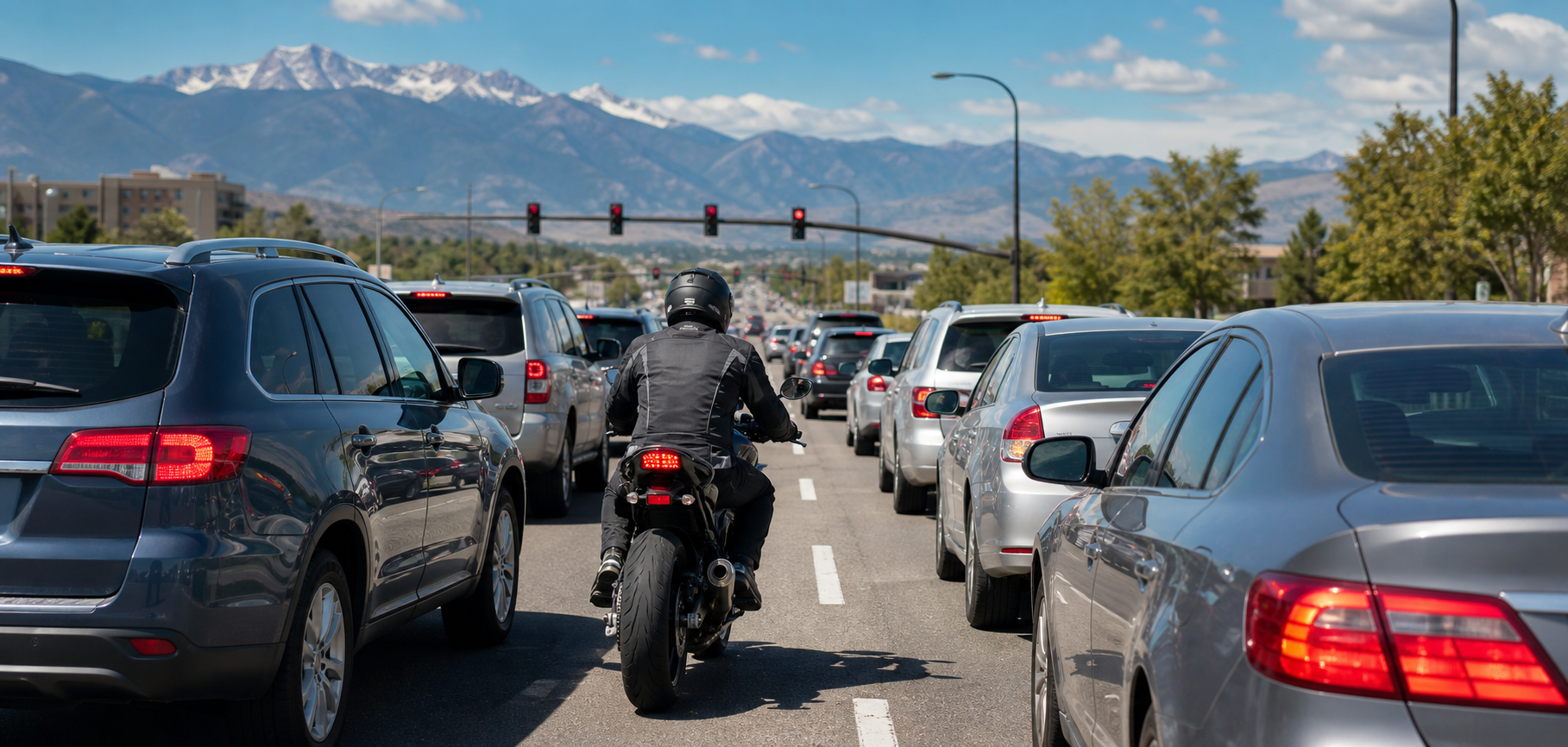
Colorado allows motorcycle lane filtering in limited situations. It does not allow lane splitting through moving traffic. For riders and drivers in Colorado Springs and throughout El Paso County, understanding that distinction can help prevent crashes, citations, and confusion on the road.
Colorado’s lane-filtering authorization took effect on August 7, 2024. It is currently scheduled to expire on September 1, 2027, unless the legislature extends or changes it.
Lane filtering vs. lane splitting
Lane filtering means a motorcycle moves carefully past vehicles that are completely stopped and traveling in the same direction. Colorado permits this only when every condition in the law is satisfied.
Lane splitting means riding between lanes or rows of vehicles while traffic is moving. Lane splitting remains illegal in Colorado.
When is motorcycle lane filtering legal in Colorado?
A rider may filter only when all of the following conditions are present:
- The vehicle being passed is completely stopped.
- Vehicles in adjacent same-direction lanes are also stopped.
- The road has lanes wide enough for the motorcycle to pass safely.
- The motorcycle is traveling at 15 mph or less while passing.
- Conditions permit prudent, controlled operation.
- The rider passes on the left and stops filtering as soon as traffic begins to move.
Slow or congested traffic is not enough. If vehicles are still moving—even at a crawl—the rider should remain in the normal flow of traffic.
Where is lane filtering prohibited?
A motorcyclist may not filter:
- On the right shoulder
- To the right of a vehicle in the farthest right-hand lane on a non-limited-access highway
- In a lane moving in the opposite direction
- Across the center line into oncoming traffic
- When the available space is not wide enough to pass safely
Filtering is optional, not required. A rider who is uncertain about the space, visibility, road surface, or behavior of nearby drivers should wait.
Safety tips for motorcycle riders
- Confirm that traffic is fully stopped before beginning to filter.
- Keep speed at or below 15 mph and be ready to stop immediately.
- Move predictably and avoid sudden changes in direction.
- Watch for opening doors, turning vehicles, pedestrians, and drivers changing lanes.
- Do not use the shoulder or cross into oncoming traffic.
- Reenter the traffic flow smoothly as soon as vehicles begin moving.
- Use protective gear and choose not to filter when visibility or road conditions are poor.
What Colorado drivers should know
Drivers may see motorcycles moving between rows of stopped vehicles at traffic lights or in gridlock. When that filtering is lawful, drivers should not block, crowd, or swerve toward the rider. Check mirrors and blind spots before changing lanes, and leave space when practical.
Motorcyclists are more exposed than people inside passenger vehicles. Predictable driving and basic courtesy can reduce the risk of a serious collision.
What happens after a lane-filtering crash?
Fault depends on the evidence. A rider may be filtering lawfully and still be struck by a driver who changes lanes or opens a door. A rider who filters when traffic is moving, exceeds the speed limit, or uses a prohibited area may also bear responsibility.
After a crash, seek medical attention, call law enforcement, photograph the scene and vehicle positions, gather witness information, and preserve video if available. Avoid making assumptions about fault before the evidence has been reviewed.
What if you receive a ticket?
Lane filtering did not create a free pass for unsafe riding. Depending on the facts, an officer may issue a citation under existing traffic laws. Check the exact charge and court date before deciding how to respond. Consequences can vary, especially when a crash or injury is involved.
How long will Colorado’s lane-filtering law remain in effect?
The current authorization is scheduled to repeal on September 1, 2027. The Colorado Department of Transportation must analyze safety data and report to the General Assembly before that date. Riders should check for updates as the sunset approaches.
Frequently asked questions
Is lane splitting legal in Colorado?
No. Riding between moving lanes or rows of traffic remains illegal. Colorado permits only limited filtering past stopped vehicles under the conditions described above.
Can a motorcyclist filter at a red light?
Potentially, yes. Traffic must be completely stopped, the lane must be wide enough, the rider must travel no faster than 15 mph, and all other safety restrictions must be met.
Can a rider filter on a one-lane road?
According to CDOT, filtering may be permitted on a one-lane road if the rider stays in the same lane, passes on the left, does not cross the center line, travels at 15 mph or less, and the other vehicle is stopped.
Does the law apply in Colorado Springs?
Yes. This is a statewide Colorado law, so the same rules apply in Colorado Springs and throughout El Paso County.
Talk with Maher & Maher Law
If you were injured in a motorcycle crash or cited after a lane-filtering incident, the facts matter. Maher & Maher Law can review the scene, the applicable traffic rules, and the available evidence.
Request a free consultation or call 719-521-5829.